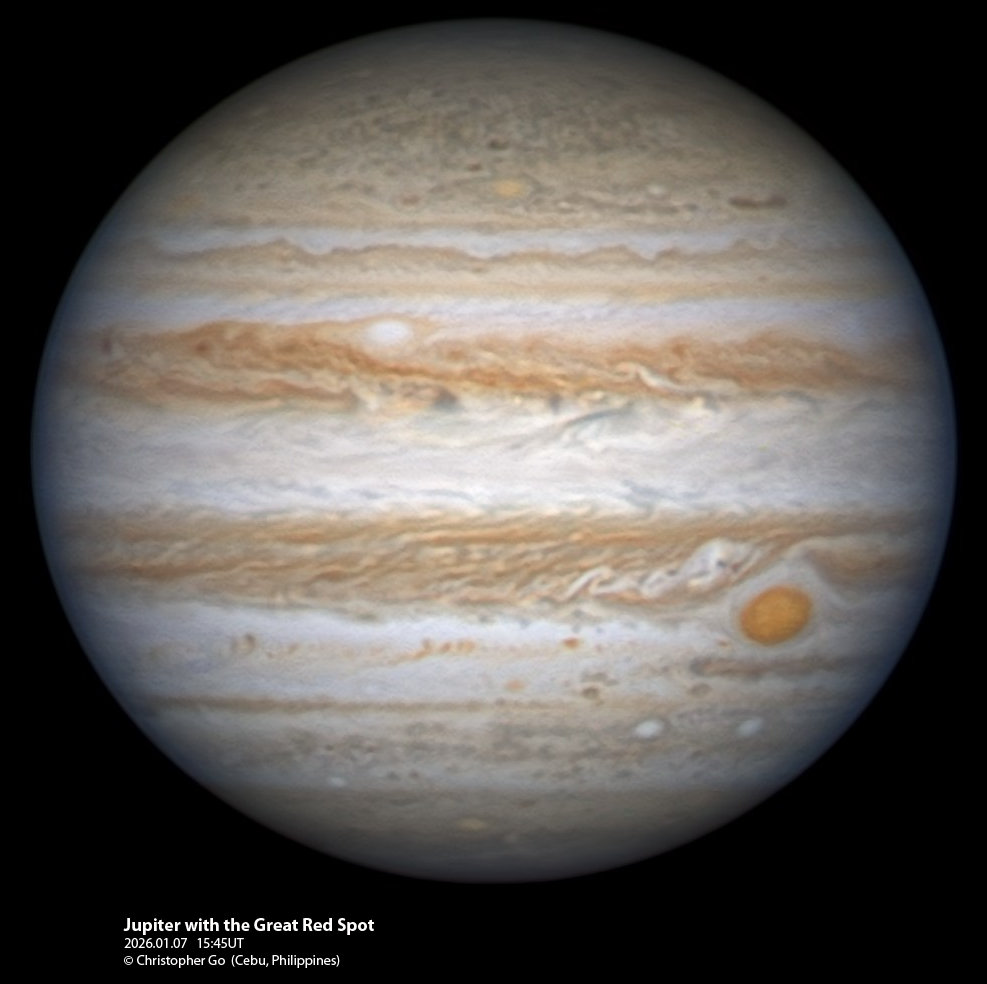
Jupiter with the Great Red Spot Júpiter con la Gran Mancha Roja
Credit: Christopher Go
Jupiter reaches its 2026 opposition today, January 10. That puts our Solar System's most massive planet opposite the Sun and near its closest and brightest for viewing from planet Earth. In fact, captured only 3 days ago this sharp telescopic snapshot reveals excellent details of the ruling gas giant's swirling cloudtops, in light zones and dark belts girdling the rapidly rotating outer planet. Jupiter's famous, persistent anticyclonic vortex, known as the Great Red Spot, is south of the equator at the lower right. But two smaller red spots are also visible, one near the top in the northernmost zone, and one close to Jupiter's south pole. And while Jupiter's Great Red Spot is known to be shrinking, it's still about the size of the Earth itself.
Júpiter alcanza su oposición de 2026 hoy, 10 de enero. Esto coloca al planeta más masivo de nuestro Sistema Solar opuesto al Sol y cerca de su punto más cercano y brillante para ser observado desde la Tierra. De hecho, capturada hace apenas 3 días, esta nítida imagen telescópica revela excelentes detalles de las nubes giratorias del gigante gaseoso, en zonas claras y bandas oscuras que rodean al planeta que rota rápidamente. El famoso vórtice anticiclónico persistente de Júpiter, conocido como la Gran Mancha Roja, se encuentra al sur del ecuador en la parte inferior derecha. Pero también son visibles dos manchas rojas más pequeñas, una cerca de la parte superior en la zona más septentrional, y otra cerca del polo sur de Júpiter. Y aunque la Gran Mancha Roja de Júpiter se sabe que se está encogiendo, todavía tiene aproximadamente el tamaño de la Tierra.